

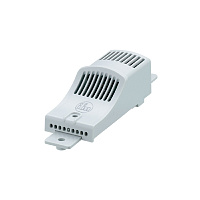
A humidity sensor uses changes in electrical capacitance to determine humidity levels. They are used for environmental condition monitoring, especially in manufacturing and industrial settings.
Humidity sensors play a critical role in maintaining optimal conditions across various processing environments. They protect equipment, ensure quality control, and optimize industrial processes.
Key features
The LDH29x air humidity sensors offers permanent temperature and humidity control. These sensors provide transparency and safety for electrical installations and sensitive production processes.
Fixtures for wall or DIN rail mounting and a standard M12 connector guarantee quick and error-free installation. This makes it possible to protect control cabinets or test benches as well as electrical installations exposed to weather and moist conditions. These include vending machines, radar measuring points or ticket machines, from moisture-related malfunctions or short circuits.
The air humidity sensor is also used for permanent indoor climate monitoring. It maintains the quality assurance of temperature or moisture-sensitive production processes.
The sensor transmits the temperature and relative humidity to the controller via IO-Link in analogue or digital form.
Analog and digital humidity sensor output options
The LDH29x sensor offers traditional 4-20 milliamp analog output for along with digital output using IO-Link technology. It offers dual output capabilities, simultaneously monitoring both temperature and humidity.
Traditional 4-20 milliamp analog systems remain common. Digital communications provide enhanced capabilities including:
- Simplified configuration
- Improved scaling options
- Multiple measurement outputs
- Resistance to ambient condition drift
Industrial humidity sensors for environmental monitoring
Industrial humidity sensors serve as the first line of defense in protecting valuable equipment and ensuring optimal processing conditions.
In electrical distribution cabinets, these sensors help prevent moisture-related damage to PLCs, motor controllers, and VFD drives by monitoring dew point conditions.
When warm, humid air meets cooled surfaces in these enclosures, condensation can form, potentially causing significant equipment damage.
Temperature sensors working in conjunction with humidity monitoring help maintain ideal conditions for sensitive electronic components.
Industrial humidity sensor applications include:
- Electronic control cabinets
- Server rooms
- Wind turbines
- Vending machines
Temperature and humidity sensors in manufacturing applications
Temperature and humidity sensors are indispensable where precise environmental control directly impacts product quality.
In metrology rooms, these sensors ensure coordinate measuring machines maintain accuracy by preventing thermal expansion and contraction of materials.
Paint shops rely on combined temperature and humidity readings to achieve proper coating adhesion and curing.
Composite manufacturing processes, such as carbon fiber production, require exact environmental conditions for optimal resin curing and structural integrity.
The benefits of combined temperature and humidity sensors
Combined temperature and humidity sensors provide comprehensive environmental control. Humidity and temperature are inherently linked. Accurate relative humidity measurements require temperature data.
Humidity and temperature sensors are essential for applications like paint shops, where specific temperature and humidity ranges must be maintained for optimal results.
Capacitive technology in humidity sensors
Modern industrial humidity sensors utilize sophisticated capacitive technology to deliver accurate measurements. The sensor design incorporates two electrodes with a hydroscopic dielectric material positioned between them.
This material captures moisture molecules, affecting the charge transmission through the sensor. The strength of this charge correlates directly with humidity levels, providing precise measurements for industrial applications.